Category

Showing posts with label science. Show all posts

Saturday, 31 January 2015

25 Unbelievable Facts That Sound Wrong

by OdieAndElsa  |  in science at  23:31

The human eye is so sensitive that, if the Earth were flat, you could spot a candle in the dark from 20 miles away

Source: imgur.com
The farthest object visible with the naked eye is the Andromeda galaxy, located 2.6 million light years from Earth.
 

If you removed all the empty space from between and within every atom making up all humans, you could fit the entire human race into the volume of a sugar cube.

The human race (or the atoms that make us) are 99.9999999999999% empty space. In theory, if you removed all that empty space, humanity could fit into the volume of a sugarcube. 


Alaska is the northernmost, westernmost, and easternmost U.S. state.

Source: imgur.com
Yes, you read correctly - Alaska is both the most Eastern and Western state. Alaska's Aleutian Islands cross from the Western Hemisphere into the Eastern Hemisphere.
 

Chances are, a pack of cards have never randomly been shuffled into the same order.

If every star in our galaxy had a trillion planets, each with a trillion people living on them, and each of these people has a trillion packs of cards and somehow they manage to make unique shuffles 1,000 times per second, and they'd been doing that since the Big Bang, they'd only just now be starting to repeat shuffles. 


One out of every 200 people alive today is a descendant of Genghis Khan

Source: mnn.com
As the ruler of one of the largest Empires in history, Genghis Khan made a serious effort to pass on his genes.


If a nickel were as big as the Earth, an atom would be the size of a nickel.

Atoms make up everything are mind-bogglingly small. In fact, if you had an atom of gold for every second that has passed since the big bang, your piece of gold would now weigh just 0.14 milligrams and be worth a few cents. 


1 out of 10 photographs ever taken in human history were taken in the past 12 months

Source: mirror.co.uk
It’s estimated that in 2014, humans will take 880 billion photos - mostly selfies.


Your blood vessels are long enough to circumnavigate Earth over 12 times.

Inside the average human body are 100,000 miles of blood vessels, enough to travel around the 7,900 mile diameter of the Earth. 
 

There are more stars in our universe than grains of sand on all our beaches.

There are around 10 sextillion stars in the universe - that’s a 1 followed by 22 zeros. On all our beaches, there’s estimated to be around 5 sextillion grains of sand. 
 

Antarctica is the world’s largest desert

Source: anpc.com
It may not seem like a desert, but Antarctica receives less than two inches of precipitation annually. The Sahara can receive up to 4 inches per year.


A line of rubik's cubes in every possible combination could reach the sun over 17 million times

If you had one rubik's cube for every possible permutation of the cube, and laid them out end to end it would stretch out for 261 light years. For perspective, the sun is 8 light minutes away and the closest star, Proxima Centauri, is four light years from Earth. 


If you could fold a piece of paper 42 times, it would be thick enough to reach the moon

Whenever you fold a piece of paper, it’s thickness grows exponentially. By the time you fold a piece of paper 20 times, it would be 6 miles high, taller than Mount Everest. That means that 42 folds would be enough to make it the 239,000 kilometers to the moon. The most we’ve ever managed is around 13.


There are more nerve connections in your brain than there are stars in the galaxy.

The number of synapses in an average human brain is in the trillions, around 0.15 quadrillion to be exact. With 100 billion stars in the Milky Way, it isn’t even a fair fight. 


If you have 57 people in a room, there's a 99% probability that at least two of them share a birthday.

Source: imgur.com
Add an extra 13 people and the chances increase to 99.99%.


There’s a rainforest in your belly button

Source: hlpain.com
Living inside the tiny hole outside your stomach is an ecosystem the size of a rainforest. From exploring 60 belly buttons, researchers found 2,368 bacterial species, 1,458 of which may be new to science.

The world's entire population of ants weighs the same as the entire population of humans.

Ants outnumber humans one million to one, making up for their small size.

The Internet weighs as much as a single strawberry

Source: tumblr.com
The vast amount of digital information in motion is made of electrons, just like everything else. It’s estimated that global Internet traffic weighs around 50 grams.

A calculator has more power than the computers that put men on the moon in 1969

It doesn’t just stop there - the iPhone5 has 240,000 times the memory of a Voyager Spacecraft.

Humans share 50% of their DNA with bananas

While we share 95% of our DNA with chimpanzees, we also share 50% with bananas. Going back in time, we both emerge from the same family tree, the tree of life, and that is why we share common characteristics.
Source: nhm.ac.uk

We have better maps of the surface of Mars than our own ocean floor

Around 72% of the Earth’s surface is covered in water. To date, we've explored only 5% of that massive area.
 

Human fingers are so sensitive that if they were the size of planet Earth, they could feel the difference between houses and cars

Human fingers are capable of detecting incredibly small nano-scale imperfections in seemingly smooth surfaces.

Plankton produce 50% of the world’s oxygen

Phytoplankton, much like trees and plants, use photosynthesis to convert light into energy. There happens to be a lot of plankton.

Russia has a bigger landmass than Pluto

Pluto is one of the largest dwarf planets that we know of. With a surface area of 1.67 x 10⁷ square kilometers, Pluto comes in as large as 3.3% of the surface of planet Earth.
Source: reddit.com

There are 16 years worth of video uploaded to YouTube every day.

That translates to a massive 6 billion hours of recorded human history every month.

The deepest part of the ocean is so deep that if Mount Everest were placed at the very bottom, the peak would still be submerged by a mile of water.

Source: wired.com
At 36,000 feet deep, Marianas trench is found in the Pacific Ocean and plays host to some of the obscurest sea life imaginable.
Tuesday, 27 January 2015

15 Most Adorable Miniature Animals In The World

by OdieAndElsa  |  in science at  00:39

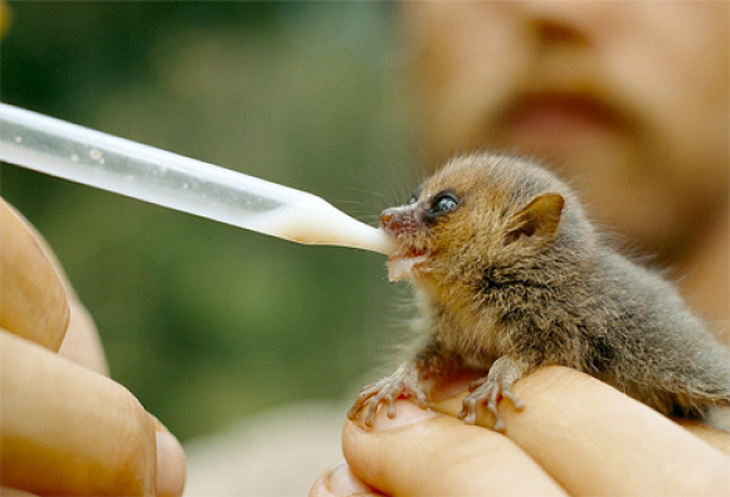
1. Mouse Lemur

Mouse lemurs have a combined head, body and tail length of less than 27 centimetres (11 in), making them the smallest primates
Tiniest Animals Mouse Lemur
Image Source: www.cutestpaw.com
The mouse Lemur of Madagascar is officially the smallest primate at 2.25 to 4.75 inches. They are nocturnal and rarely leave the trees.  They were just recently discovered and are endangered due loss of their limited habitat. (source)


2.  Mr. Peebles

Mr. Peebles was named after a ventriloquist’s dummy on an episode of “Seinfeld.”
World’s smallest cat, Mr. Peebles
Image source: www.smalleststuff.com
This photo was taken when Mr Peebles was two years old and weighed just over two pounds. He measured approximately 6.1 inches and could perfectly fit into a pint glass. (source)


3. Chihuahua Milly

When she was born, Milly weighed less than an ounce and fit in a teaspoon
Smallest dog
Image source: www.dailymail.co.uk
Smallest dog1
Image source: www.dailymail.co.uk
Milly, the Chihuahua is just 3.8 inches high. She lives in the North East Puerto Rican town of Vega Alta. She was born in 2011 and had to be fed using an eye dropper. She can easily fit into a teaspoon. (source)
Also see: 15 Rare And Unique Albino Animals


4. Pink Fairy Armadillo

The pink fairly armadillo has large front claws that allow them to move underground as if they are swimming through water
Pink Fairy Armadillo
Image Source: www.wired.com
This one may not be adorable since the Pink Fairy armadillo is a strange creature and is rarely seen. It is the smallest armadillo and it’s the only one that has a dorsal shell that is separated completely from its body. It can be found in the dry grasslands and sandy plains of central Argentina. They measure at least 3.3 to 4.6 inches. (source)


5.  The world’s smallest Horse, Einsteen

Einstein shows no dwarf characteristics and is simply a very small miniature horse.
Einstein, the world's smallest horse.
Image Source: www.theguardian.com
Einsteen is the world’s smallest horse. In April 2010, he weighed just 6lb (2.7kg) and stood at a mere 14 inches (35.5 cm) tall (Source 1, 2)


6. Hamster Peewee

Peewee stopped growing when he was three weeks old
Peewee
Image Source: www.itthing.com
This adult hamster weighs less than an ounce and measures less than an inch in length. If you compare Peewee to a normal size hamster, he looks like a newborn. (source)


7. Pygmy slow loris

The pygmy slow loris is adorable but its bite is toxic
Pygmy slow loris
Image Source: www.duke.edu
It is a native to forest habitats of Laos, Vietnam, China and Eastern Cambodia. It is listed as vulnerable to extinction due to collection for its medicinal values and pet trade and also due to habitat destruction. However cute it is, if you keep it as a pet, be aware of its bite because it toxic. (source)
 
 
8. Kenyan pygmy chameleon 
The Kenyan Pygmy originates from the dry forests and scrublands of the Mombasa district in Kenya, and so prefer a slightly lower ambient humidity
Kenyan pygmy chameleon
Image Source: www.exotic-pets.co.uk
It lives primarily in the hot and humid coastal forests. They are gray in color and often have horizontal stripes. The head has a flattened casque and no rostral process. They have a short tail and their chin, tail and face are adorned with numerous tubercles and scale clusters.  (source)
Also see: Animals That You Didn’t Know Exist.


9. Pygmy Hippo

Adult pygmy hippopotamuses can reach six feet in length and weigh up to 600 pounds.
pygmy hippo
Image Source: www.pygmyhippofoundation.org
It’s mostly found in the swamps and forests of West Africa and is endangered. The hippo is vulnerable due to loss of habitat but also due to poaching and hunting. It is estimated that only 3,000 of these hippos are left.(source)


10. Pygmy marmoset

The pygmy marmoset is known to be the smallest known species of monkey in the world.
marmoset pygmy
Image Source: pin.primate.wisc.edu
They have a head the size of a human thumb and are the smallest monkeys in the world. They are mainly found in the rainforests of the Amazon Basin. They use their sharp nails to cling onto branches and their specialized teeth to feed on tree gum. They also eat fruits, insects and nectar. see how they love the toothbrush. (Source 1, 2)


11. Pygmy Owl

The Pygmy-Owl doesn’t let size stand in its way; this fierce little owl frequently preys on birds and mammals larger than itself.
pygmy owl
Image Source: www.owlpages.com
The pygmy owls are tiny but fierce. There are roughly 25-35 species of them in the world but they are mostly found in Western North America and Central America. They mostly eat insects, lizards, small birds and rodents. This is what happens when you tickle them.  (source)


12.  Pygmy seahorse

The pygmy seahorse has the incredible ability to blend in with its surroundings.

This seahorse is about 2 centimeters in length and exceptionally good at blending with its host coral.  (source)


13. Pygmy possum

Pygmy possums range in length from about 5 to 12 cm and usually weigh between 10 and 50 grams
pygmy possum
Image credit: Phil Spark(flikr)
There are five pygmy possum species; four found in Australia and one in Indonesia and Papua New Guinea. They are about 2.8 to 3.5 inches long and have a 3 to 4.3 inches long nail. They are easily preyed on by owls. (source)


14. Pygmy mongoose

The Dwarf Mongoose is the smallest African mongoose
pygmy mongoose
Image source: www.awf.org
It’s also known as the dwarf mongoose because it’s the smallest of its species -it’s Africa’s smallest carnivore. They can be found in various habitats but especially near termite mounds where they love to sleep. (source)


15. Pygmy shrew

Fully grown Pygmy Shrews are around a quarter of the size of a House Mouse.
pygmy shrew
Image source: www.freenatureimages.eu
There are three species of this species in the world- the Eurasian pygmy, the American pygmy and the Etruscan pygmy. It’s the smallest of its species with a pointed snout and greyish-brown fur. It grows to about 1.4 inches in length but eats about 1.5 to 2 times its weight. (source)

10 Bizarre Scientific and Drug Related Experiments Done on Animals

by OdieAndElsa  |  in science at  00:34
Scientists have been known to do some not so ethical things over the years in order to get the results they need. In particular, there have been many eyebrows raised and arguments had over animal experiments. From crazy drug experiments, to surgical head switches, scientists seem to make no exception when it comes to science. Take a look at this list of some of the most bizarre scientific experiments involving drugs, surgeries, and things you wouldn’t even imagine done on animals over the years.

1. Robot Monkeys

Robot Monkeys
Image credit: Andrew Schwartz/University of Pittsburg (taken from)
Advertisement
In an order to perform and demonstrate brain-machine interface technology, In 2008, researchers from the University of Pittsburgh and Carnegie Mellon University, used two monkeys with small devices in their brains have learned to control a robotic arm with just their thoughts. They used it to reach for food and even adjust the size and stickiness of morsels when necessary. This experiment was done to shed new light on prosthetic limbs for human patients who can benefit from more high tech artificial limbs. (source)

2. Zombie Dogs

Zombie dogs
Image source
Zombie dogs
Image source
In 2005, American scientists created a pack of zombie dogs by using technique similar to ‘cryogenation’. The team killed the dogs by flushing all the blood from their bodies. Three hours later, the team gave the dogs a blood transfusion, and electric shock. The dogs were resurrected, and while some had permanent damage, most were fine. (source)

3. Human Ear Grown On Mouse

Human Ear Grown On Mouse
Image courtesy: wikipedia user Gobonobo(taken from)
In 1997 American scientists were able to attach a human ear to the back of a mouse. This was done to see if it was possible to grow limbs and organs outside of the human body. Science is moving forward now and testing other resources. (source)

4. Pig Powder

Pig Powder
Image source: www.earthtimes.org
According to University of Pittsburgh’s McGowan Institute of Regenerative Medicine, researchers have conducted a way to scrape the lining of a pig’s bladder, decellulize it, dry it into a powder. They managed to regrow a human finger using this powder. This powder could be the answer for those seeking an answer to lost limbs. (source)

5. Sexually Stupid Turkeys

Turkey head on a stick
Image source
Martin Schein and Edgar Hale of the University of Pennsylvania did an experiment on Turkeys in which they killed a female turkey and slowly removed limbs and body parts until all that was left was a head on a stick. Never did the male turkey lose any sort of sexual interest what was shown to it. (source)

6. Monkey Head Transplant

monkey heads
Image source
On March 14, 1970, Robert White performed a head transplant on a monkey to out do another surgeon who had already performed a dog head transplant years earlier. Soon after the monkey awoke, it became angry and tried to attack Dr. White. The monkey survived less than two days. (source)

7. Glow in the Dark Cats

Glow in the dark cats
Image source
In 2007, South Korean scientists transformed a cat’s DNA to make it glow in the dark and then took that DNA and cloned other cats from it — creating a set of fuzzy glowing toms. (source)

8. Web Spinning Goats

Web Spinning Goats
Image source
According to Nexia, “Researchers inserted a spiders’ dragline silk gene into the goats’ DNA in such a way that the goats would make the silk protein only in their milk. This “silk milk” could then be used to manufacture a web-like material called Biosteel.” (source)

9. Rats on Ecstasy

cutest_rat_youve_ever_seen_640_31
Image source
A scientific study showed that rats who were given ecstasy (MDMA) demonstrated having more sex while loud bass heavy music was playing while control rats who were also listening to the same music did not demonstrate as much sexual activity. (source)

10. Trippin’ Tusko

Trippin’ Tusko
Image source
Unfortunately in 1962 when Tusko the elephant was injected with LSD, he died within two hours. There is much debate about what actually killed him but I’m sure we can all agree that his dying moments were INSANE. However, recently elephants were tested again with LSD in their water with much better results giving hippie elephants like Tusko hope all around the world. (source)

Monday, 26 January 2015

20 Mind Blowing Facts that are very hard belive

by OdieAndElsa  |  in science at  23:43

1) There are more living organisms on the skin of each human than there are humans on the surface of the earth.

via http://i.telegraph.co.uk

2) Each person sheds 40 lbs of skin in his or her lifetime.

http://runningfather.files.wordpress.com/2013/12/shedding-skin.jpeg


3) Males produce one thousand sperm cells each second – 86 million each day.

via http://scienceline.org


4) One in every 2000 babies is born with a tooth.

via http://webtablab.com/wp-content/uploads/2011/04/weird-news-7.jpg


5) Human saliva contains a painkiller called opiorphin that is six times more powerful than morphine.

via Shutterstock


6) Girls have more taste buds than boys.

via http://www.komputerswiat.pl


7) When a flea jumps, the rate of acceleration is 20 times that of the space shuttle during launch.

via http://4.bp.blogspot.com/


8) Gorillas and potatoes have two more chromosomes than humans do.

via Shutterstock


9) A pig’s orgasm lasts for 30 minutes.

via http://images.dailystar-uk.co.uk


10) Koalas sleep an average of 22 hours a day, two hours more than the sloth.

via http://namonitore.ru/uploads/catalog/animals/spyashaya_koala_1280.jpg


11) The African Elephant gestates for 22 months.

via http://www.wired.com/


12) A dog’s sense of smell is 1,000 times more sensitive than a humans.

via http://www.dogster.com/files/dog-smelling-boots.jpg


13) Octopuses have three hearts.

via http://3.bp.blogspot.com


14) At over 2000 kilometres long The Great Barrier Reef is the largest living structure on Earth.

via https://blog.wwf.org.au/wp-content/


15) The name of the first human being in the Norse mythology is Ask

via blogs.nature.com


16) The Queen is the legal owner of one-sixth of the Earth’s land surface

via https://blog.wwf.org.au


17) As it grows, sweet corn makes a squeaking noise like two balloons rubbing against each other.

via http://2.bp.blogspot.com/-vovQ7iLVDcY/T-Sx1c


18) Wounds infested with maggots heal quickly and without spread of gangrene or other infection. (IT’S JUST A MASK IN THE PICTURE!)

via http://4.bp.blogspot.com/


19) Biologically speaking, bugs are insects that “suck”.

via http://www.dan-dare.org/FreeFun/


20) If the 5 trillion spiders in Netherlands took to eating humans rather than insects, they’d consume all 16.7 million Dutch people just in three days.

via http://www.impactlab.net/wp-content/uploads/2010/05/spiders.jpg

Proudly Powered by Blogger.